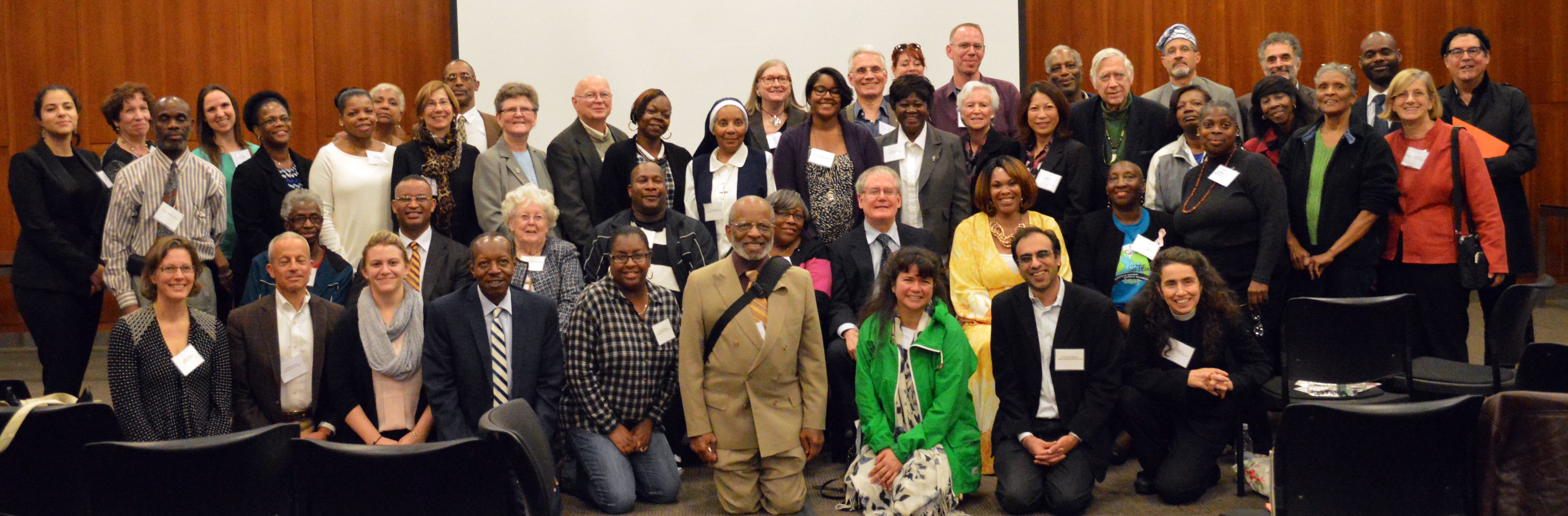
Participants at the 33rd Marshall Meyer Retreat
Program Overview
The long-running Rabbi Marshall T. Meyer Retreat for Social Justice is one of New York City’s principal venues for interfaith dialogue on social justice issues. The semi-annual MMR conferences and retreats are professional development and capacity building opportunities for local religious leaders, allowing faith leaders to learn about social issues, create multifaith networks for mutual support, and meet civic leaders and social activists. The retreats are named after the late Rabbi Marshall Meyer, former spiritual leader of Congregation B’nai Jeshurun, and a faith-based social justice visionary.
The retreats focus on four objectives, seeking to: (1) educate grass roots religious leaders about social issues impacting New York communities, from both interfaith and secular perspectives; (2) build formal and informal networks of support for the city’s religious leaders engaged in social justice work; (3) connect the city’s religious communities with society’s secular institutions; and (4) generate strategies for addressing common social justice concerns. Over the course of nearly two decades, the program has served many hundreds of religious and civic leaders from all corners of New York.
For more information about the Marshall Meyer Retreats, please contact ICNY’s Director of Programs Dr. Henry Goldschmidt at 212-870-3514 or henry@interfaithcenter.org.
Upcoming Retreats
Past Retreats
2023
(41st) Faith in Action for Food Justice
2022
(40th) Housing Now: Faith Communities’ Call to Action
2021
(39th) New York Faith Communities Respond to Gun Violence
2020
(38th) The Climate Crisis and New York Faith Communities
(37th) Faithful Responses to the Overdose Crisis: Building Congregations and Communities of Care
2019
(36th) Welcoming the Stranger: Taking Action Together for Immigrants’ Rights
2018
(35th) Multifaith Strategies for Nonviolent Direct Action
2017
(34th) Faith-Based Lending and Economic Empowerment: Helping Diverse New Yorkers Build American Dreams
(33rd) Hospitality in a Time of Hate: Religious Leadership for an Inclusive City under the Trump Administration
2016
(32nd) Youth Speak Out!
2015
(31st) Coming Home: Faith Communities Supporting Successful Re-entry
2014
(30th) Harnessing Spirituality and Religion in End of Life Care
As follow up to this retreat, ICNY held a similar program exclusively for Staten Island religious leaders.
2013
(29th) Child Welfare and Foster Care
(28th) Widening the Lens on Community-Police Relations: Comparisons Across Cities New York, Glasgow, Barcelona, Los Angeles
(27th) The Challenge of Homelessness: Strategies to Provide Support and Restore Hope
2012
(26th) Together in Service: Building Interfaith Partnerships for Social Action
2011
(25th) Creating Safety, Preserving Faith: Religious Leaders Respond to Domestic Violence
2010
(24th) Building Sacred Space in the City: Religious Freedom in Bricks and Mortar
(23rd) Building Economic Resilience in Faith Communities
2009
(22nd) Immigration: From Estrangement to Engagement
(21st) Confronting Hate Crimes
2008
(20th) Investing In Our Future: The Health of Children & Youth
(19th) Growing Older and Wiser in an Aging City
2007
(18th) Cultivating Hope: Planting Seeds of Environmental Justice in NYC
(17th) Faith as a Force for Recovery: Substance Abuse and Addiction
2006
(16th) Mental Health
2005
(15th) Religious Communities and Conflict Mediation
(14th) Religious Communities and Domestic Violence
2004
(13th) Getting Health Care Access in New York City
(12th) Religious Diversity in New York’s Public Square: Religious Accommodation New York’s Public Schools and Hospitals
2003
(11th) Poverty and the Justice System
2002
(10th) Poverty in New York City
(9th) Post 9-11 Challenges to Religious Communities in New York.
2001
(8th) Immigration and Immigrants Rights
(7th) Youth Leadership and Social Action- an intergenerational Retreat
2000
(6th) Transformative Justice
(5th) The Contribution of Religious Communities to the Education of Children and Youth
1999
(4th) Roots of Violence & the Reimagination of Community
(3rd) Youth and the Search for Identity
1998
(2nd) Patterns of Incarceration and the Prison System
(1st) Immigration, Police Brutality, Identity, and Youth