On Wednesday, April 18, the Jain Center of America, New York (located in Elmhurst, Queens) welcomed the public into their worship space for a night of education and sharing. Coordinated by Mrs. Kalpana Gandhi, president of the Jain Center of America, New York, and Kevin Childress of The Interfaith Center of New York (ICNY), the event was attended by about 25 guests and Jain hosts. Visitors of note included ICNY board members TK Nakagaki and Kusumita Pedersen, as well as representatives of The Rubin Museum, several religious leaders, and students from Hunter College.
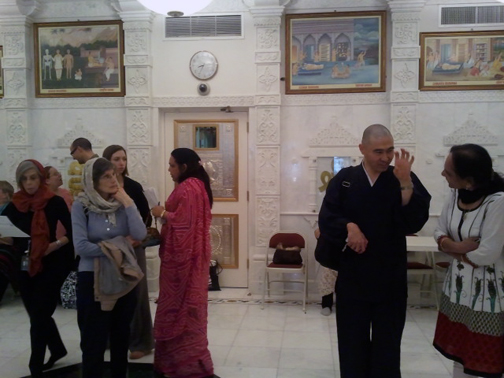
Because Jain practice is to never eat after sunset, the evening was prefaced with an early communal vegan meal of curry, rice, yogurt and many other delicious dishes, graciously prepared by volunteers of the Jain Center. As people dined, they learned about the principle of “ahimsa” (non-violence) and the dietary ways in which this tenet is observed by Jains, through a strict vegetarianism that includes the avoidance of root vegetables such as potatoes and carrots, the planting and harvesting of which can result in the deaths of insects in the soil.
After the meal, guests and hosts gathered in a prayer hall for an introduction to the Jain religion, which professes non-violence for all living beings. With origins dating back more than 2,500 years, there are about 4 million Jains in India today, and a growing presence in America and elsewhere. The word “Jain” is derived from the word “Jina,” the term for a soul that has conquered the passions which taint one’s soul with bad karma.
Several of the guests asked about the repeated use of the swastika design in Jain art and iconography. The swastika, we learned, is an ancient emblem that, for the Jains and people of many other faiths, greatly predates the 20th century associations of intolerance and hatred. This symbol actually dates back thousands of years, and has been used in many cultures and religions to convey a spiritual message about the cycles of death and rebirth which all souls should strive to be liberated from.
Our guide and teacher, Ms. Susmita Mehta, led us through numerous temples throughout multiple floors of the building, each featuring a place a worship that uniquely reflects the ritual practices of a particular Jain sect. For example, the Mahavirswami Temple on the 2nd floor is shown below:
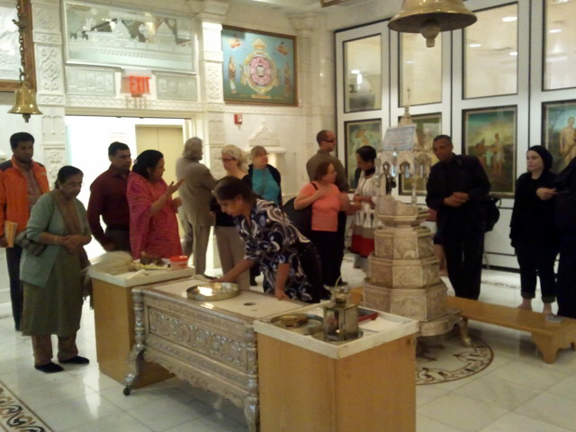
This light and airy temple was fragrant with the scent of incense, and featured paintings and statues of “Jina” whose souls have achieved perfection. In this temple, the figures are clothed and ornamented, in keeping with the tradition of the Swetamber group of Jains who are often called “White Clad,” in reference to the type of garment members of this sect traditionally wear.
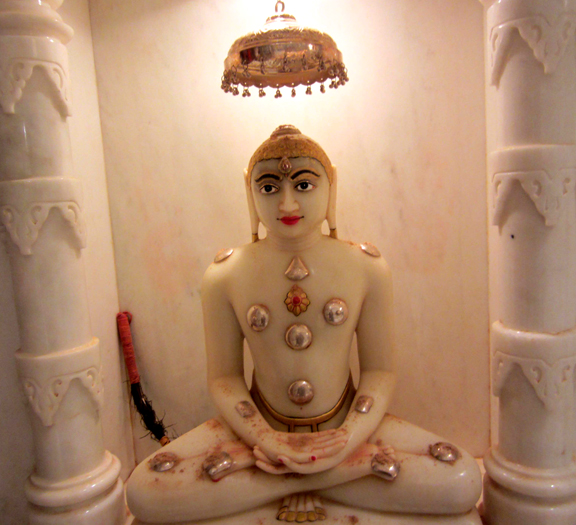
In this temple, Ms. Gandhi led the group before a group of Jina statues, showing us how to pray to the Jina for guidance. “The jina is like a mirror,” Ms. Gandhi observed. “They remind each of us that our souls are also perfect. We pray to the jina to help us find our way to that perfection.”
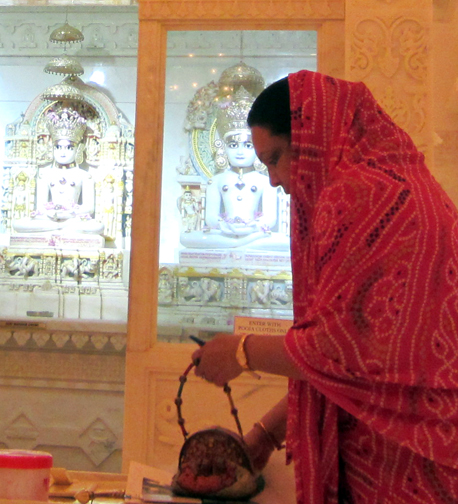
The main temple on the 3rd floor is called Adinath Jinalaya, and is the worship space for the Digamber group of Jains who are also called “Sky Clad,” in reference to the practice of shedding all clothing once the soul has achieved a near-perfect state of liberation. The deital figures in this temple were corresponding unclothed. Other temples, including the Ashtapad Mah Tirath, were made of impressive collections of Jina statues carved from precious stones.
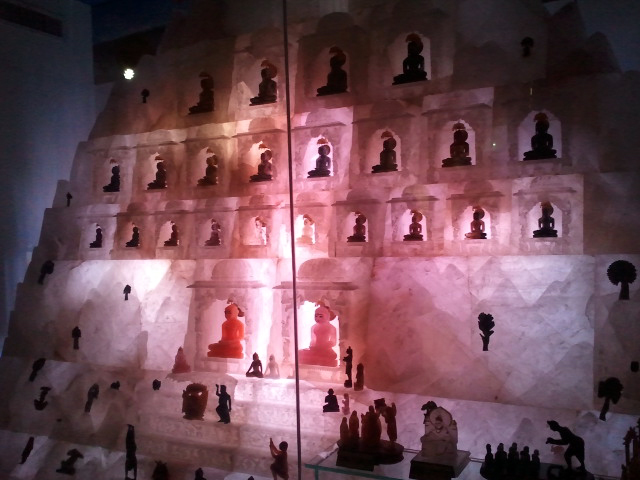
It is remarkable that each of the five temples in this Center is specifically designed for a particular Jain sect, and that outside the temples – in the dining hall, libraries, and meeting rooms – all Jains interact. This would be akin to a mosque containing prayer spaces for both Sunni and Shia followers, or a Christian church containing different chapels for Lutherans, Baptists, Mormons, etc. For the Jains, this arrangement makes perfect sense. “We all follow the same philosophies,” Ms. Gandhi noted, “Only the ritual observances vary.”