The Importance of Learning about “Lived Religion”
Or, What’s the Deal with that Orange on Your Neighbor’s Seder Plate?
by Dr. Henry Goldschmidt, ICNY Director of Education Programs
ICNY offers education programs for a wide range of audiences in New York and beyond, including secondary school teachers and students, social workers, religious leaders, and the general public. Each of these audiences has its own particular needs and concerns, so each of these programs has its own distinctive methods and focus. But there are a number of common themes running through our education programs, and one of the most important is the study of lived religion.
“What the heck does that mean?” I can hear some readers asking. The term lived religion has its roots in academic scholarship (in the work of the historians and anthropologists like David Hall, Meredith McGuire, and especially Robert Orsi) but it’s not just an ivory tower concern. Indeed, it speaks to important truths about religious belief and practice that can help us all develop a richer understanding of our religiously diverse society. I’ll explain why by contrasting the study of lived religion with more conventional approaches to the study of religion, and then I’ll give a brief example. (I promise we’ll get to that orange eventually!)
All too often when we learn about an unfamiliar religious tradition, we focus on the doctrines, texts, and historical figures at the heart of the entire tradition, to the exclusion of any serious discussion of the diversity within all religious traditions. So, for example, we try to understand Islam by studying the Five Pillars, a few selections from the Qur’an, and the life story of the Prophet Muhammad; or to understand Buddhism through the Four Noble Truths, a sutra or two, and the life story of the historical Buddha. This “dates and doctrines” approach to religious diversity may give us the answers to straightforward factual questions about our neighbors’ religious traditions, but it doesn’t give us any real understanding of our neighbors’ religious lives.
By contrast, the study of lived religion takes the everyday practices, discourses, and experiences of specific religious communities as the starting point for any discussion of religious diversity. It recognizes that the world’s 1.6 billion Muslims, for example, may have dramatically different understandings of the doctrines and texts at the heart of their tradition. Rather than limiting the study of religion to canonical doctrines and rituals, a focus on lived religion encourages us to explore popular beliefs and practices – all the creative things that people do with their traditions, and even the things they do that may depart from their traditions. Because really . . . does anyone simply “follow” a religious tradition, mindlessly applying a static body of received doctrine? No one I’ve met in my work at ICNY, to be sure. This is a dangerous oversimplification of religious faith, and the study of lived religion helps us get past it, to develop a richer understanding of the religious worlds all around us.
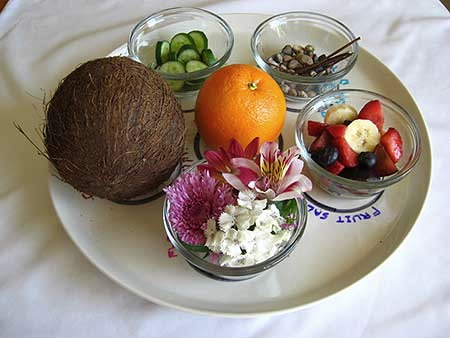
Which brings me, at last, to the orange that may (or may not) have been sitting on your neighbor’s seder plate during Passover last spring. If you’ve ever studied Judaism – even the reductive “dates and doctrines” version – you probably know that many Jews commemorate the ancient Israelite exodus from Egypt with a ritual meal known as the Passover seder. In the middle of a seder table, sandwiched between the matzah and Manischewitz, one generally finds an ornate plate of five or six symbolic foods representing central themes of the Passover story – horseradish to mark the bitterness of slavery, a lamb shank bone to recall the paschal sacrifice on the eve of the exodus, and so on. Thus far we are solidly in the realm of canonical doctrine, ritual, and text. The symbolism of these foods, and even their placement on the plate, is specified fairly clearly in the Talmud and other rabbinic texts. But what about that orange? And that coconut? There’s nothing to be found about these foods in traditional Jewish texts, but there they are anyway – in the photo just above, and in quite a few American Jewish homes. What’s up with that?
Well the story goes that some time in the 1980s, an influential male rabbi told the Jewish feminist scholar Susannah Heschel that “A woman on the bimah [ie, a female rabbi] is like an orange on a seder plate [ie, inappropriate and out of place].” The story is most likely apocryphal (a lovely euphemism for made up), but it got around anyway. And beginning in the 1990s, a growing number of Jewish feminists and their families began putting oranges on their seder plates to mark their commitment to gender equality in Jewish life. Once this got going, other Jews began to use other foods to mark their concern with other social or ethical issues. An olive or an olive branch on the seder plate shows one’s support for a just peace between Israel and Palestine. A coconut shows support for LGBTQ Jews, who are too often forced to hide their true selves in Jewish communal life, like the rich meat locked within the hard shell of a coconut. Indeed, some Jews take this ritual innovation a subversive step further, including a small crust of bread on their seder plate to show support for LGBTQ Jews, despite (or perhaps because of) the clear prohibition in Jewish law on eating leavened bread during Passover, let alone placing it on the seder plate.
These are just a few examples of contemporary lived religion – of the extraordinary religious creativity we ignore when we limit discussions of religious diversity to the “dates and doctrines” of major traditions. There is nothing in canonical text or doctrine telling your Jewish neighbors to put an orange on their seder plate, or do yoga in synagogue, or for that matter give their daughter a Bat Mitzvah, but you can’t understand American Jewish life without an understanding of practices and experiences like these.
ICNY’s education programs acknowledge the importance of lived religion by encouraging faith leaders and others to share their personal experiences of religious life – not just their views of canonical doctrines and texts. Our programs thus give New Yorkers and others the subtle, empathic understanding of religion they need to be full participants in a pluralistic society.
Photo Credit http://velvetparkmedia.com/blogs/not-your-grandma’s-seder