Coordinated by ICNY Summer Interns Katherine Maxeiner, Allegra Wiprud, Natasha Japanwala
On a Monday evening, in a stuffy room on the Upper West Side, a conversation took place that all too rarely occurs. Over a dozen women gathered to discuss the place of women within religious traditions that are for the most part patriarchal. For an hour and a half, women from a diverse range of faith backgrounds discussed the challenges of being active members and figures of authority within their religious communities; and while fighting against the patriarchy is challenging, all agreed that it was a necessary challenge. All, both speakers and participants, believed that there is a need for religious women to be advocates for change, both within and beyond their particular faith communities. Such an opinion was apparent from the beginning, when the five speakers shared their own experiences. These women included Sr. Aisha Al-Adawiya of Women in Islam, Inc., Anindita Chatterjee Bhaumik of CONNECT, Rabbi Laurie Gold of Jewish Home and Hospital for the Aged, Rev. Jeanne Person of General Theological Seminary, and Sr. Susan Wilcox of St. Joseph College. Their stories laid the floor for the following heart-to heart dialogue with the participants.
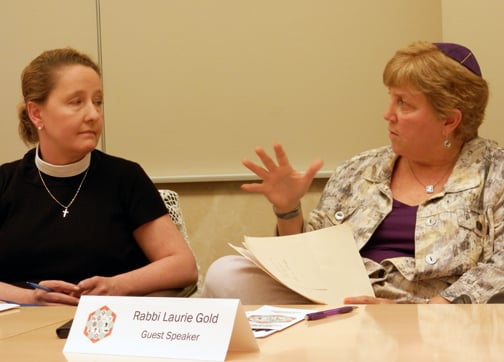
(Pictured left to right: Rev. Jeanne Pearson, Rabbi Laurie Gold)
The focus question for panelists and participants was on how they have negotiated a comfortable place for themselves within their faith traditions. One panelist strikingly said she could not answer that question; instead, she frankly said “I’m not comfortable.” Despite coming from very different religious traditions, all felt that carving a place for themselves as female leaders within their traditions was an obligatory struggle and an uphill battle that is far from won. Regardless of whether they were official or unofficial leaders within their religions, all felt that getting their voices heard was incredibly challenging. Therefore, it was hardly surprising, after devoting much of their lives to creating a voice for themselves within their faith communities, that all emphasized the need to be advocates and instruments of change – not only should women work for enlarging the place for women within their own religion but they should also be involved in universal social issues, such as poverty. Inaction was a concept vastly foreign to the women speaking; for in their eyes, if something is worth having, it is worth fighting for.
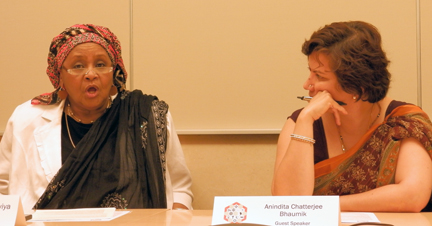
(Pictured left to right: Sister Aisha al-Adawiya, Anindita Bhaumik)
Following the speakers, the floor was left open to the participants. The agenda for the evening was purposefully left open so that the discussion could go in any direction the participants chose. Consequently, a variety of topics were touched upon while important ones remained to be addressed. One of the primary issues of concern was how to keep young women within the folds of their religious traditions so that in times of crisis, these young women had support that was both communal and spiritual. Also of importance was the concern that the messages male leaders within the religious communities are sending, both through their actions or lack thereof, repel women from involvement with their faith communities. Part of this same theme was the desire that more people were aware fo the distinctions between religion and culture.
Unfortunately, time constraints meant that not every issue could be raised or given the attention it deserved. At the end of the session, we paused for participants to list issues that were not discussed. On the most basic level, the question of what, exactly, equality and authority meant to everyone and what shape both should take needed to be answered. The flow of the conversation suggested that everyone shared an assumption that there is a natural leadership role for women in faith communities, and that it means equality with existing structures of authority. The meaning of equality and authority themselves remained up in the air. Further, how does one engage with voices that do have different conceptions of what words like equality and authority mean in relation to women in religious traditions? Other issues that were raised but not discussed included female sexuality, attempting to redefine what can be discussed within houses of worship, and how to help women who are disempowered but long to speak up.
Although by the end of the session we felt as though we’d barely started, we as organizers feel that the evening was incredibly productive in helping to raise participants’ awareness of the importance of interfaith dialogue. Many participants were extremely glad that this conversation was taking place across faith lines, as interfaith dialogue often helps people to be more candid about their opinions than when speaking within their particular religious tradition. It is our hope that even through humble discussions like this, increased solidarity can be built that fosters allyship between women and men so that all voices are able to be heard within and beyond in our faith communities.